
Excerpts from the Building Material Growers Program Guidebook
Carbonization
Carbonization gives the bamboo a warm darker tone, and improves the material’s durability and water resistance. The carbonization process involves heating the bamboo to temperatures of 1,800 to 2,200 degrees Fahrenheit in a limited oxygen environment. The lack of oxygen prevents the bamboo from burning and instead causes the fibers to thermally decompose. This decomposition process causes certain organic compounds to be removed, which changes the material’s color and physical properties.
Growth Rates
| Species | Growth Rate |
| Madake (Phyllostachys reticulata) | 47.6 inches (121 cm) per day |
| Moso Bamboo (Phyllostachys edulis) | 46.8 inches (119 cm) per day |
| Tropical Giant Bamboo (Dendrocalamus asper) | 35 – 40 inches (90 to 100 cm) per day |
| Oldham’s Bamboo (Bambusa oldhamii) | 12 – 24 inches (30 – 60 cm) per day |
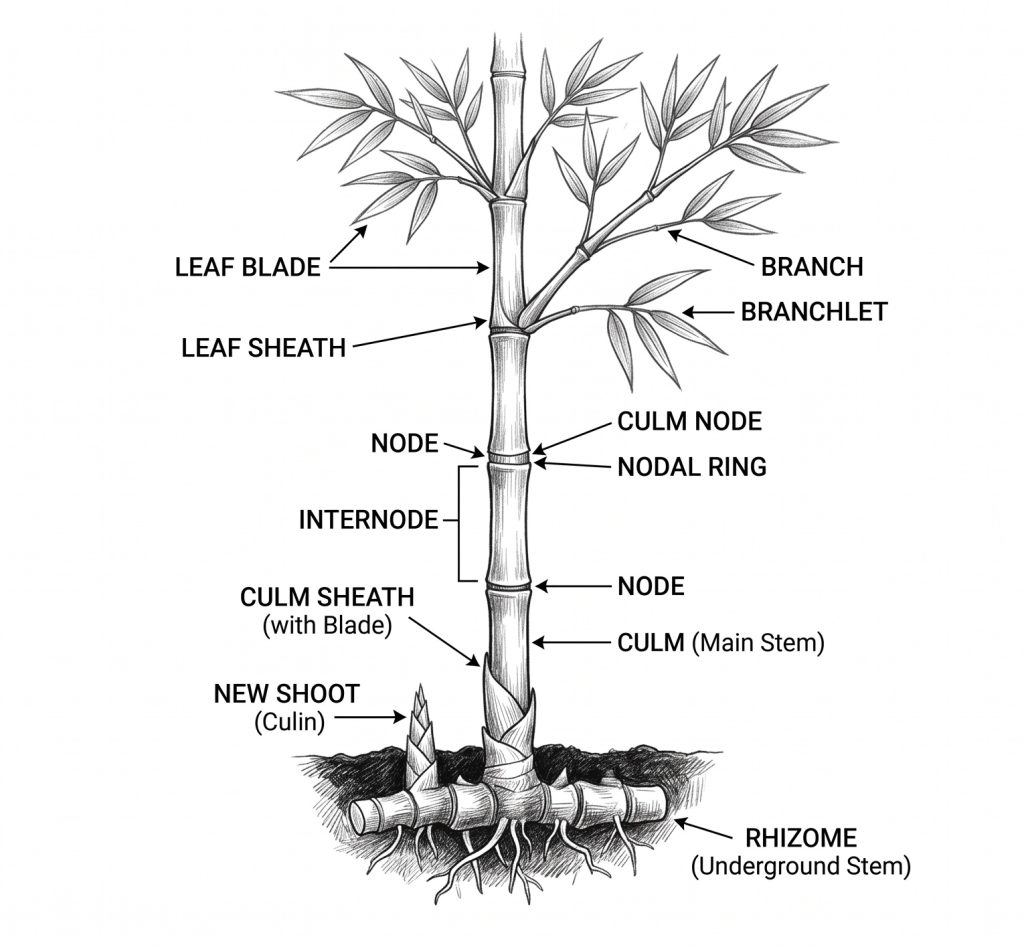
Anatomy of a Bamboo Plant
Bamboo Chemical Composition
Bamboo Chemical Composition
Cellulose: 70% – 74%
Hemicellulose: 12% – 14%
Lignin: 10% – 12%
Extractives (proteins, waxes, and pectin): 2% – 3%
Wood (for comparison)
Cellulose: 40–50%
Hemicellulose: 20–30%
Lignin: 21–23%
Protein: 0.2–0.5%
Mineral matter: 1–5%
Woody Volume Per Stalk
Giant Timber Bamboo (Bambusa oldhamii): Grows 40 to 50 feet tall with a 4-inch diameter. An average stalk produces around 2 to 3 cubic feet of woody volume.
Moso Bamboo (Phyllostachys edulis): Grows 50 to 75 feet tall with a 4 to 6-inch diameter. These stalks yield about 3 to 5 cubic feet of woody volume.
Tropical Giant (Dendrocalamus giganteus): Up to 100 feet tall with a massive 10 to 12-inch diameter. A single stalk can produce between 8 to 20 cubic feet of woody material.
(1 cubic foot = 12 board feet)
Shaping
Bamboo naturally grows in rigid straight lines. However, it is possible to achieve curved forms using bamboo. There are a few methods to do so. The first is the soaking method. Soaking the bamboo in water allows moisture to penetrate the woody stalk which plasticizes key organic binders like hemicellulose and lignin, making the material flexible. Another method of shaping bamboo is the heat method. Bending bamboo with heat softens the natural resins lignin and pectin.
Fabrics
The three main types of fabrics produced from bamboo are Viscose (Rayon), Lyocell, and Mechanically-Produced (Linen). Viscose and lyocell are produced by first breaking the bamboo down into a cellulose pulp, and then dissolving the pulp using either an inorganic or organic solvent to create a liquid solution. The liquid solution is then transformed into fine threads. Mechanically produced bamboo involves mechanically crushing the bamboo and then using enzymes such as pectinases to soften the fibers which are then combed and spun into yarn.